
I usually hear about the ERP integration after everyone is already tired of it.
Not at the beginning, when the plan still sounds clean and exciting. Not when someone is saying things like “seamless data flow” and “real-time inventory visibility” in a conference room.
I usually hear about it later.
Orders are missing. Inventory is wrong. B2B customers are seeing prices they should not be seeing. Someone in the warehouse is manually checking Magento against the ERP because nobody quite trusts the sync anymore. And every time the developer “fixes” one piece of the integration, something else gets weird.
That last part is usually the tell.
Because when a Magento 2 ERP integration starts behaving like a haunted machine, the problem often is not one bad API call. It is the shape of the whole thing.
The Magento 2 ERP Integration Problem Nobody Wants to Admit
Magento is very good at certain things.
It is good at complex catalogs. Customer groups. Tier pricing. B2B rules. Custom checkout flows. Weird product structures. Things that simpler ecommerce platforms start choking on pretty quickly.
And ERP systems like NetSuite, Microsoft Dynamics, SAP, Acumatica, or whatever industry-specific system a company has grown around, those are good at a different set of things. Inventory. Fulfillment. Accounting. Purchasing. Warehouse logic. Customer-specific terms. The unglamorous backbone of the business.
The trouble starts when someone tries to make the two systems behave like they are one system.
That sounds nice in theory.
In practice, it can turn into a brittle, slow, very expensive knot.
A common version looks like this: Magento is hosted somewhere solid, maybe Nexcess, and the ERP is doing its own thing somewhere else. Then a connector extension gets installed. Then a few custom scripts get added. Then some “temporary” fixes get layered on top. Then someone directly modifies behavior they should have extended properly. Then a pricing rule does not quite map correctly, so another exception gets added.
A few years later, nobody fully understands the integration anymore.
And that is usually when I get involved.
The Tuesday Morning Phone Call
I am making Tuesday up, mostly. But it does seem to happen on Tuesdays.
A store owner or operations person reaches out and says some version of:
“We have Magento 2 connected to our ERP, but it keeps failing.”
Then the details start coming out.
Orders are not always reaching the ERP. Inventory updates are delayed by hours. A customer places an order for 300 units that do not actually exist. Contract pricing is correct in the ERP but wrong in Magento. Or correct in Magento, wrong in the ERP. Or correct on Monday, wrong on Wednesday, which is somehow more annoying.
And the most painful part is that the business has usually already paid real money to solve this.
Magento was not cheap. The ERP was not cheap. The integration was not cheap. The hosting was not free. The meetings were definitely not free.
So when the whole thing still requires manual babysitting, there is a very specific kind of exhaustion in the room.
I know that feeling. Not personally as the store owner, but I have sat in enough of these messes to recognize it.
The Spaghetti Code Trap
A lot of failing Magento ERP integrations are built as direct, point-to-point connections.
Magento talks directly to the ERP. The ERP talks directly back to Magento. Sometimes that is handled through an off-the-shelf connector. Sometimes through custom code. Sometimes through a folder full of scripts that everyone is afraid to touch.

This can work fine for simple cases.
But B2B Magento stores are often not simple cases.
They have customer-specific pricing. Parent and child accounts. Company structures. Credit terms. Approval workflows. Split shipments. Custom SKUs. Tier pricing. Inventory rules that depend on warehouse location, customer type, or both. Products that are sellable online but fulfilled in strange ways.
So the integration grows.
And grows.
And grows.
At some point, every small change becomes risky.
That is the spaghetti code trap. The integration is not a clean pathway anymore. It is a pile of exceptions.
Real-Time Everything Is Usually a Bad Idea
This is one of the first things I look for.
Some integrations try to make everything happen in real time. A customer adds a product to the cart, Magento checks the ERP. A price loads, Magento checks the ERP. An order is submitted, Magento waits for the ERP. Inventory changes, Magento waits again.
That may sound responsible.
It is often a performance disaster.
If Magento has to pause and knock on the ERP’s door every time something important happens, then your ecommerce site is only as fast and reliable as the slowest part of that chain.
If the ERP is busy, Magento slows down.
If the ERP is offline for maintenance, Magento starts failing.
If the API rate limit gets hit, checkout becomes unreliable.
If 500 B2B customers place complex orders at the same time, you may discover that “real-time integration” actually means “real-time traffic jam.”
Not everything needs to be real time. Some things do. Many things do not. The nuance matters.
That is where a lot of integrations go wrong.
The First Thing I Do: Map the Actual Data Flow
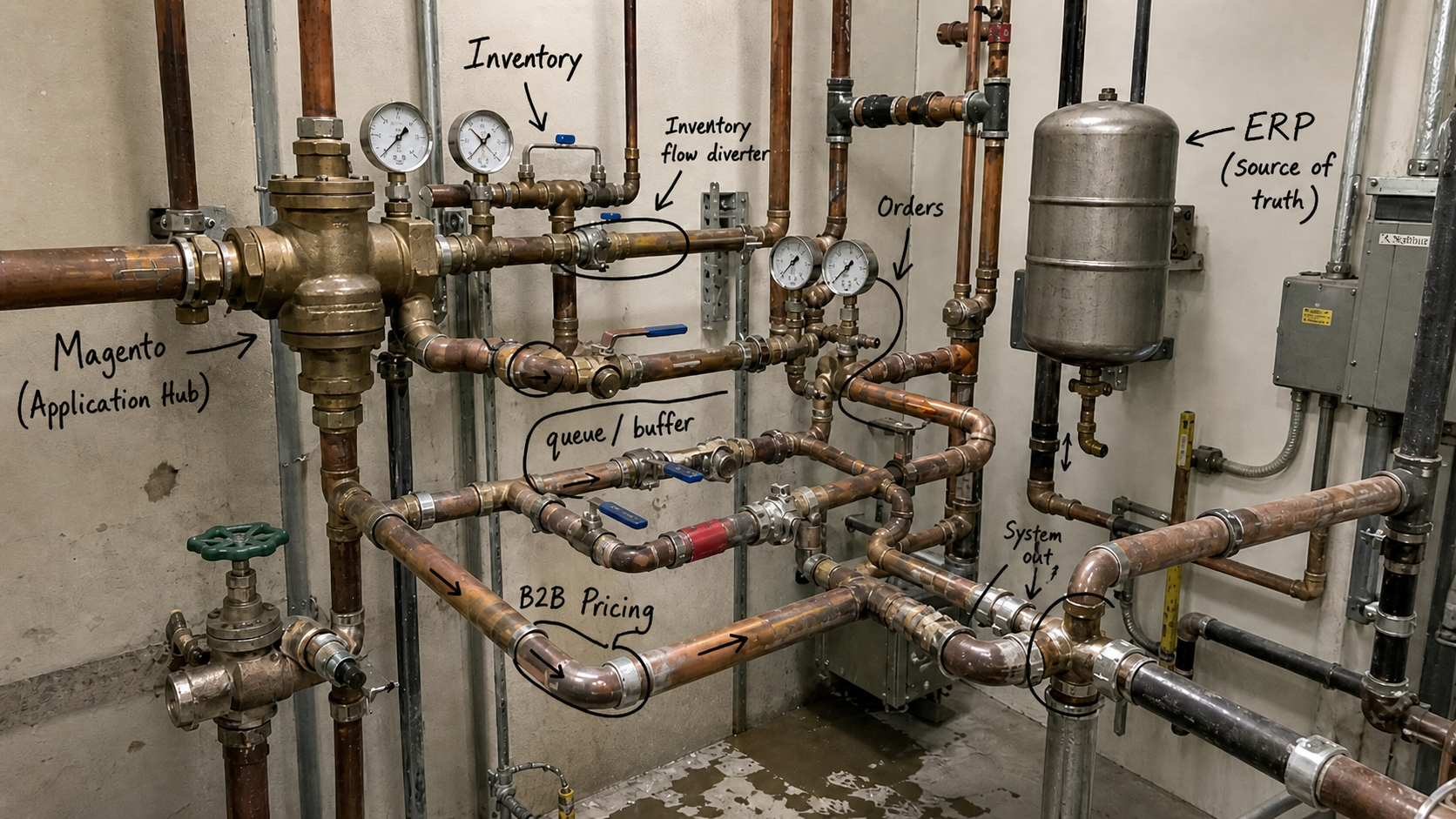
Before I touch code, I want to understand what data is moving, when it moves, who owns it, and what happens when something fails.
That sounds boring.
It is not.
Well, okay, it is a little boring. But it is the useful kind of boring.
I want to know things like:
Which system is the source of truth for product data?
Which system owns inventory?
Where does customer-specific pricing live?
Does Magento need exact live inventory, or does it need a safe sellable quantity?
What happens when the ERP rejects an order?
Are failed syncs visible to humans, or do they disappear into a log file nobody reads?
Can a failed job be retried safely?
Are orders idempotent, meaning we can resend them without creating duplicates?
That last one is not glamorous, but it matters a lot. A fragile integration does not just fail. It fails in ways that create cleanup work. Duplicate orders. Missing shipments. Confused customers. Weird accounting artifacts that haunt someone’s Friday afternoon.
I do not want that.
So I map the flow first.
Magento Should Not Be Treated Like a Data-Routing Engine
This is one of my bigger opinions.
Magento is the ecommerce application. It should be excellent at presenting products, handling customers, supporting checkout, applying Magento business rules, and creating orders.
But Magento should not be forced to become the central nervous system for every piece of business data.
That is how stores get slow. That is how upgrades get terrifying. That is how a checkout issue turns into an ERP issue turns into a warehouse issue turns into a three-week project.
For most serious Magento 2 ERP integrations, I prefer a middleware layer.
That middleware might be an integration platform. It might be a custom service. It might be something lightweight and purpose-built. The exact tool depends on the business.
But the principle is the same.
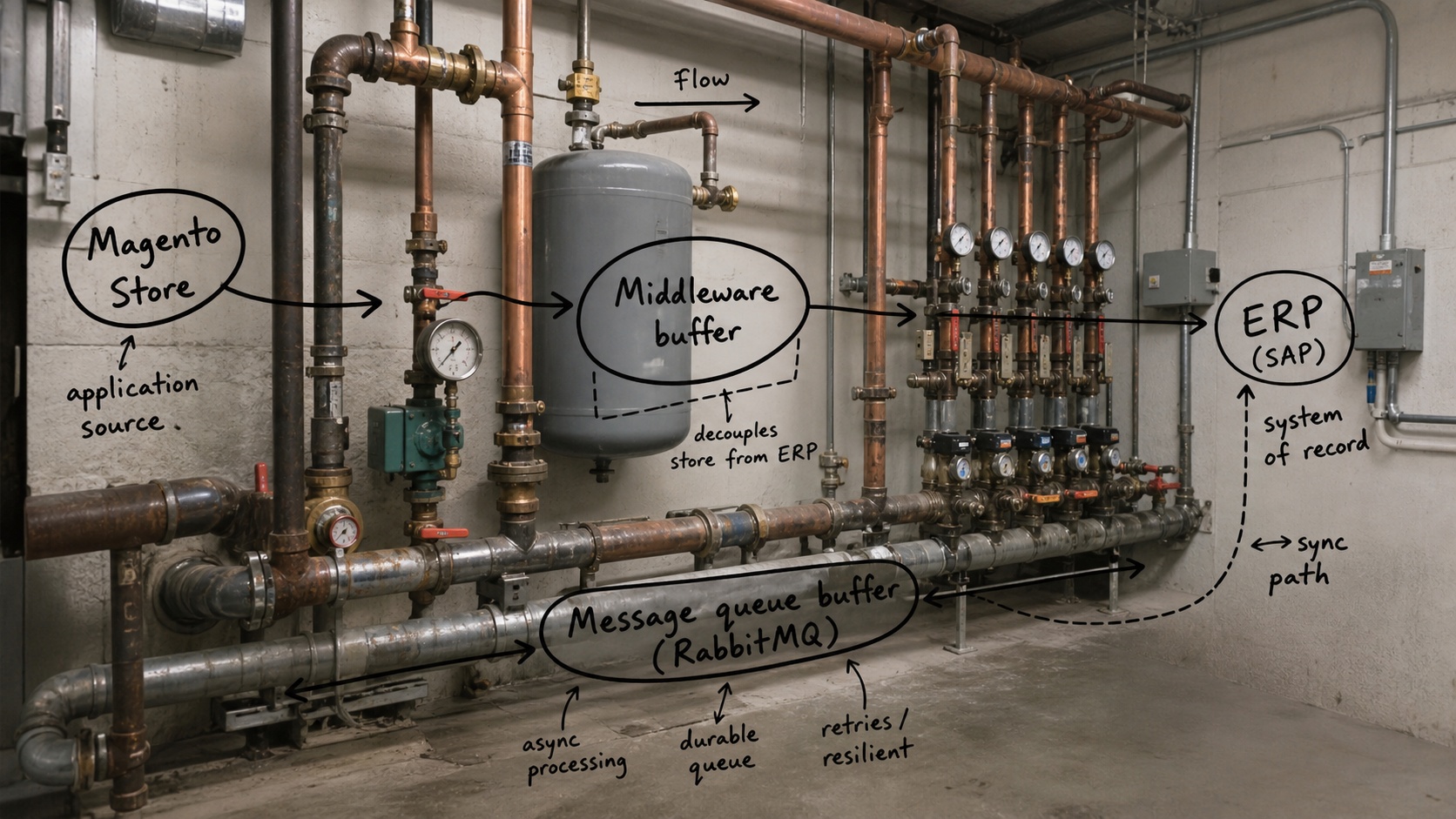
Magento sends structured data to the middle layer. The middleware transforms it, validates it, logs it, and passes it to the ERP in the format the ERP expects.
The ERP can send data back the same way.
That gives us a buffer.
And a buffer is a beautiful thing in ecommerce.
The Middleware Layer Is Where the Translation Belongs
ERP data is rarely shaped the way Magento wants it.
Magento wants product data one way. The ERP may think about products another way entirely. Magento has its own rules for configurable products, grouped products, customer groups, price indexes, stock status, and quote behavior. The ERP may have item numbers, warehouse codes, price levels, customer classes, and legacy fields that made perfect sense in 2008 and now just sort of exist.
Someone has to translate.
A lot of broken integrations do that translation directly inside Magento.
I try not to.
The middleware layer is a better place for that work because it can handle the ugly middle without polluting Magento’s core architecture.
It can say, “This ERP customer type maps to this Magento customer group.”
It can say, “This ERP price level becomes this Magento tier price.”
It can say, “This inventory value should update salable quantity, but only after we apply this safety buffer.”
It can also log the whole thing clearly so that when something fails, we know what failed, why it failed, and whether it can be retried.
That is not fancy. It is just sane.
Message Queues: The Quiet Hero of Magento ERP Work
Magento 2 has native support for message queues, and on a serious store, especially a B2B store, they can make a huge difference.
RabbitMQ is the common choice here.
The idea is simple: do not make the customer wait for every background system to finish talking.
If an order needs to go to the ERP, Magento can place that task into a queue. If inventory needs to update, queue it. If pricing needs to sync, queue it. The website keeps serving customers while background workers process the jobs.
This matters a lot on hosted environments like Nexcess, where you want the web-facing side of the store to stay responsive. You do not want big catalog syncs, ERP calls, or inventory updates competing with real customers trying to check out.
Queues also make failures less catastrophic.
If the ERP is temporarily down, the job can wait. If a record fails validation, it can be flagged. If a sync needs to be retried, we can retry it without asking someone to manually reconstruct an order from screenshots and panic.
I am not saying queues magically solve everything.
They do not.
Bad queue design can still create chaos. But properly used, queues let Magento breathe.
The Golden Rule: Do Not Hack Core
I wish this did not still need to be said, but it does.
We do not modify Magento core files.
Not for ERP integration. Not for pricing logic. Not for checkout changes. Not because “it is just one small change.”
That path leads to pain, and we have inherited a core-hacked store enough times to know the pain well.
Magento is already complex enough without turning future security patches into archaeology projects. If we need custom behavior, we build custom modules. We use dependency injection. We use service contracts where appropriate. We use plugins, observers, APIs, and extension attributes carefully. Carefully is the key word.
Because Magento gives developers plenty of ways to customize things, but not all customizations are equal. Some are clean. Some are clever in the bad way. Some look fine until the next upgrade.
ERP integrations should be built with future upgrades in mind from the beginning.
Because there will be upgrades. There will be security patches. There will be PHP version changes. There will be extension conflicts. There will be business changes.
The integration needs to survive normal life.
The Part Lots of Devs Skip: Failure Handling
A good integration is not one that never fails.
That is not realistic.
APIs fail. Servers time out. Credentials expire. ERP systems go down for maintenance. Someone changes a field name. A weird customer record shows up with data nobody expected.
A good integration knows what to do when failure happens.
That means failed jobs are logged clearly. Alerts go to the right people. Retries are controlled. Duplicate orders are prevented. Partial syncs are visible. Bad records are quarantined instead of poisoning the whole batch.
This is where a lot of “working” integrations are not really working.
They are only working when everything else is perfect.
That is not enough for a real B2B operation.
If your business depends on Magento and the ERP agreeing with each other, the integration needs to be designed for imperfect conditions.
Especially because imperfect conditions are the normal ones.
Inventory Syncs Need Special Care
Inventory is usually one of the most sensitive parts of the integration.
Too slow, and you oversell.
Too aggressive, and you hammer the ERP or slow down Magento.
Too simplistic, and you show customers inventory numbers that do not reflect real fulfillment logic.
A good inventory sync is not just “copy ERP quantity into Magento.”
Sometimes you need safety stock. Sometimes you need warehouse-specific availability. Sometimes you need to treat certain SKUs differently. Sometimes B2B customers can buy into backorder, but retail customers cannot. Sometimes the ERP quantity is technically true but commercially misleading.
This is where I slow down and ask annoying questions.
Not because I enjoy making meetings longer. I really do not.
But because “inventory” is often not one thing. It is a business rule wearing a number costume.
If we do not understand the rule, the sync will be wrong.
Pricing Is Even Worse
Pricing is where integrations go to get humbled.
B2B Magento pricing can involve customer groups, shared catalogs, tier pricing, negotiated pricing, quantity breaks, MAP restrictions, promotions, contract pricing, and ERP-level price rules that were built over the course of years.
So when someone says, “We just need pricing synced,” I get a little suspicious.
Not in a dramatic way. Just in a quiet, developer-with-a-coffee way.
What kind of pricing? Base price? Customer-specific price? Contract price? Tiered price? Promotional price? Currency-specific price? Price after an ERP discount rule? Price before Magento catalog rules? What wins when two rules conflict?
This needs to be mapped.
Otherwise the integration will technically sync pricing while still being wrong.
And wrong pricing is one of those problems that gets expensive quickly. It can cost margin. It can damage customer trust. It can make sales reps furious. Sometimes all three.
What “Fixed” Actually Looks Like
When a Magento 2 ERP integration is rebuilt properly, the result is not usually dramatic from the outside.
The site just becomes calmer.
Orders reliably reach the ERP.
Inventory updates happen in the background without dragging down the storefront.
Pricing rules stop randomly changing.
Failed syncs are visible and recoverable.
Developers can apply Magento patches without fear that the ERP integration will explode.
The operations team stops keeping secret spreadsheets to verify whether the system is telling the truth.
That last one is a big deal.
When people inside the business stop building manual backup systems around the integration, that is when you know the architecture is finally doing its job.
Why This Saves Money Later
A messy Magento ERP integration can feel cheaper at first.
Install the connector. Add a script. Patch the edge case. Move on.
But the cost comes later.
It comes in slow checkout. Failed orders. Emergency developer hours. Upgrade delays. Security patches that cannot be applied cleanly. Staff time spent manually reconciling data. Customers leaving because their pricing or inventory is wrong.
A cleaner architecture usually costs more thought upfront, and sometimes more development upfront.
But it reduces the chaos tax.
That is the part I care about.
Not just making the integration technically work, but making it maintainable enough that the business is not trapped by it.
Magento 2 ERP Integration Failing? Start With the Architecture
If your Magento 2 ERP integration is failing, the answer may not be “find a better connector.”
Maybe. Sometimes.
But often the real issue is that Magento and the ERP have been wired together too tightly, with too little attention to queues, middleware, ownership of data, failure handling, and upgrade-safe Magento architecture.
That is the work I like doing.
It is not glamorous in the brochure sense. Nobody is going to put “clean asynchronous ERP retry logic” on a billboard.
But when orders stop disappearing, inventory stops lying, and the team stops manually checking the ERP every morning, it feels pretty glamorous to the people running the business.
And honestly, that is good enough for me.
If your Magento 2 ERP integration is failing, I can review the current setup, map where the data is breaking down, and show you what needs to change structurally. Not another patch on top of the patch. The actual shape of the fix.