
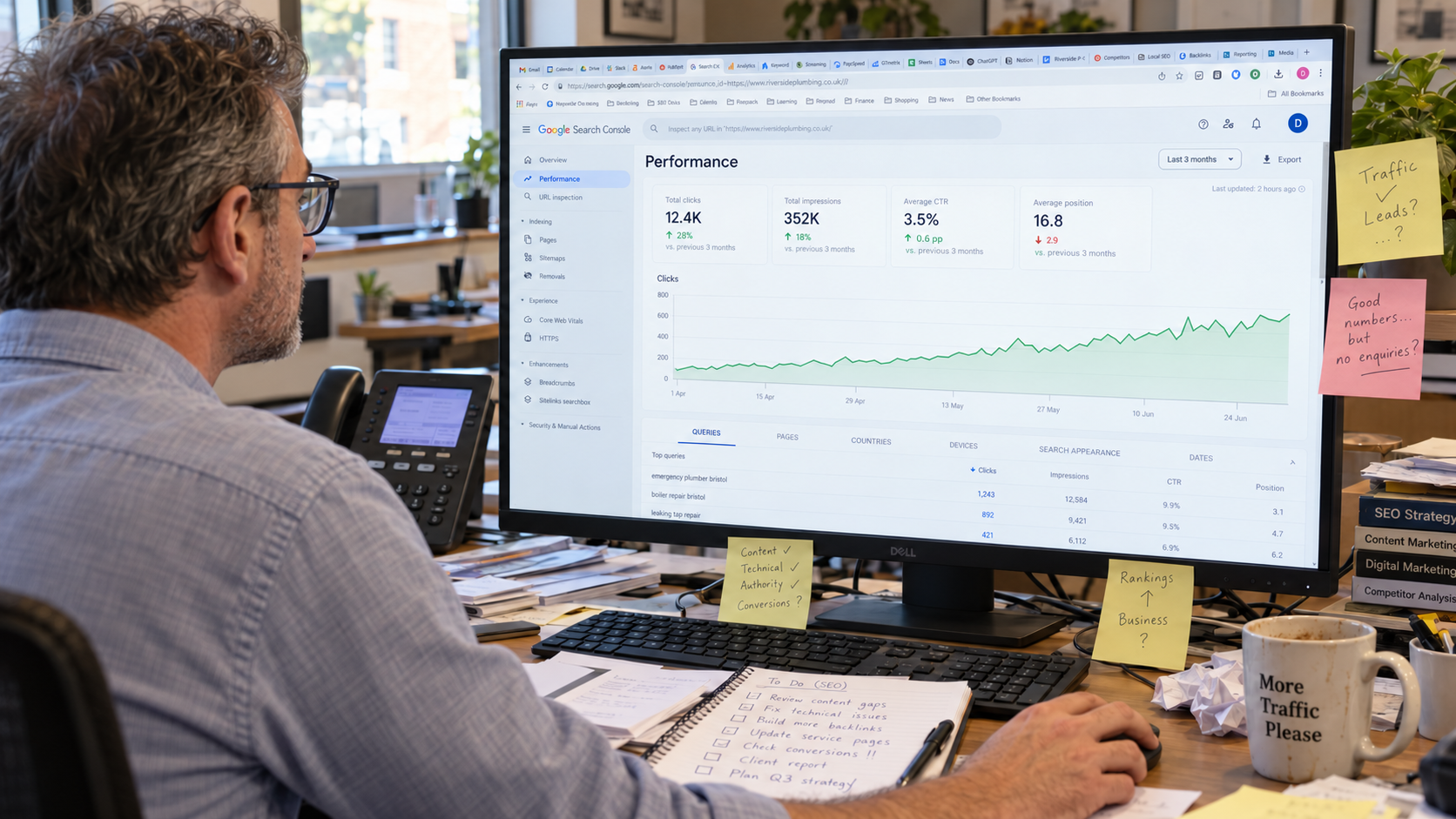
What I look for after 20+ years in the business when rankings and traffic are improving, but the business isn’t feeling it—and where AEO and AI can help.
There’s a particular kind of SEO report that makes me want to pull up a chair and ask a few more questions. Traffic is up, rankings have improved, and everything is presented in reassuring shades of green. Meanwhile, the person paying for all of this is looking at their inbox and wondering where the customers went.
If that’s you, I think you’re asking exactly the right question. You shouldn’t need to learn Google Analytics just to understand whether your website is helping your business. And when you ask your provider why inquiries haven’t improved, you deserve an answer that connects the work to something you can actually recognize as progress.
Watermelon Web Works has been building and improving websites since 2002. My instinct here is to follow the person who might become your customer. What did they search for? Where did they land? Did the page help them? Could they figure out whether you were the right company to call? Somewhere along that journey, there’s usually something worth investigating.
Are We Attracting People Who Might Actually Hire You?
More traffic sounds good. We like more traffic! But I want to know who those visitors are and what brought them to the site before I get too excited about the graph.
Suppose you run a local accounting firm. A blog post explaining a basic tax term might attract readers from all over the country, including students, other accountants, and people who want a quick definition. That article could have value, but its popularity doesn’t tell me much about whether local business owners are discovering your tax-planning services.
I also want to separate people searching for your company name from people searching for something you do. Both matter. Someone who already knows you should be able to find you easily. But if most of your search traffic comes from people who already know your name, there may be a substantial opportunity to reach people who haven’t met you yet.
This is where keyword research becomes useful. I want to understand the questions, problems, and decisions that bring a potential customer to your website. A smaller audience with a relevant problem can be far more valuable than a large audience collecting trivia and heading elsewhere.
What Happens After Someone Gets There?
Once we have the right visitor, I put myself in their shoes and try to use the site. This is a wonderfully simple exercise that can uncover some surprisingly expensive problems.
Can I tell what the company does? Does it work with organizations like mine? Is there an example that gives me confidence? If I have a question, can I ask it without surrendering my life story and booking a Tuesday afternoon discovery experience?
Sometimes the blog is helpful, but the connection to the business is faint. The reader gets an answer, reaches the bottom, and is invited to read another article about something only vaguely related. Other times, the service page is full of polished language that could describe practically any company. Everyone offers exceptional solutions. I’m still trying to find out whether you can fix my particular mess.
Then there are the practical obstacles: an awkward mobile layout, a form that asks too much, a broken confirmation message, or a page that becomes slow at exactly the wrong moment. There’s often a few small obstacles between “this looks promising” and “I’ll contact them.”
Before I recommend publishing another dozen articles, I want to make sure we’re giving the visitors you already have a reasonable chance of becoming customers.
If this sounds familiar, send me your website and a recent SEO report. Tell me what kinds of inquiries you want more of, and I’ll help you make sense of what needs a closer look.
A Case Study: Everything Looked Fine Until Someone Tried to Buy
One WooCommerce project sticks with me because the store looked reasonably healthy from the outside. Product pages loaded quickly, category pages behaved themselves, and SEO traffic was still arriving. You could browse around and conclude that things were working pretty well.
Then you clicked Add to Cart and waited about seven seconds.
Seven seconds is a long time to stare at a button while wondering whether you’ve clicked it correctly. People click again. They hesitate. They begin reconsidering their relationship with the entire internet. And this was happening right where the store needed to make buying feel easy.
After investigating the database and cleaning up accumulated data and old plugin leftovers, we brought the cart response down to about 0.4 seconds. We wrote up the investigation in this WooCommerce performance case study, including the detours, because these problems don’t always introduce themselves politely.
That improvement made it much easier for someone to buy. It also illustrates why I look beyond search traffic: the website has a job to do after the visitor arrives, whether that’s completing a purchase, requesting an estimate, registering for an event, or asking a useful question. We need to check that part of the experience too.
What About AEO? Shouldn’t We Be Showing Up in AI Answers Too?
Yes, AI search definitely belongs in the conversation today. People are using AI assistants and AI-generated search answers to research problems, compare options, and discover businesses. If your provider hasn’t discussed that with you, it’s reasonable to ask how it fits into the plan.
AEO stands for answer engine optimization. It’s commonly used to describe work that helps your information become discoverable and useful in those answer-based experiences. The terminology is still settling down, which has apparently done nothing to slow the production of new acronyms.
My starting point is the questions your prospective customers ask before they hire you. What does the service cost? Can you handle their situation? What are the alternatives? How does the process work? What might go wrong, and what do you do about it?
If the answers are buried in someone’s head or scattered across old proposals, they aren’t doing much for your website. Publishing clear, specific answers gives people more useful information to work with and creates content that search systems can discover and reference.
For Google’s AI search features, the familiar foundations still apply: helpful content, accessible pages, clear internal links, and reliable information. Google’s guidance says special AI markup isn’t required for inclusion. I’d be wary of treating a mysterious technical checkbox as the entire AEO strategy.
I also want to keep the reporting grounded. Being mentioned in an AI answer is worth observing, but I still care about whether the business is reaching relevant people and earning useful inquiries. If your provider shows you a screenshot of your company appearing in an AI answer, that’s encouraging. My next question is whether we’re seeing that visibility translate into relevant visits or hearing from prospects who found you that way.
Your Website May Be Underrepresenting How Much You Know
This is one of the more encouraging problems I find. A business has years of experience, thoughtful people, and good answers to difficult customer questions. Then I look at the website and find a short service description that barely scratches the surface.
There’s plenty to work with. We just haven’t put it to work yet.
When I talk about topical authority, I’m describing useful depth around the subjects your business knows well. Someone should be able to explore their problem on your site, understand their options, see evidence of your experience, and find the service that fits.
For that accounting firm, a tax-planning service page could connect to practical articles about when to start planning, what to bring to an initial meeting, how a business transition changes the conversation, and common mistakes the accountants keep helping people untangle. Those articles support the same area of expertise while answering different questions.
That’s the idea behind a hub-and-spoke structure. The main service page is the hub, and the supporting resources are the spokes. Thoughtful internal links help people move between them as their questions become more specific.
I like this approach because it gives the content a purpose. We can explain why an article exists, who it helps, and how it connects to the business.
Where Topical Authority AI Earns Its Keep
Organizing all of this takes work. Someone has to review what already exists, find the gaps, plan useful additions, maintain the connections, and keep the writing sounding like the business. That last part matters more than some people think. Your customers shouldn’t feel as though the website has suddenly been taken over by a very enthusiastic brochure.
This is the work we’ve been building Topical Authority AI to support. It helps organize WordPress content around core topics, identify gaps in coverage, and connect supporting articles to the appropriate hub pages. It also supports developing content in the site’s established voice, so new material can feel like it belongs there.
AI is particularly useful at coordinating related information and helping turn a scattered publishing effort into something more deliberate. With clear direction, it can help map customer questions and develop drafts within an organized structure. That makes it easier to build out a subject thoroughly without asking someone on your team to spend every Friday staring at an empty document.
The substance still needs your experience. I want real examples, accurate explanations, and someone checking whether the advice makes sense. I get a little twitchy when a content plan consists of “publish more” without much discussion of what anyone is supposed to gain from reading it.
We explain that approach in How to Use AI for SEO Without Creating Junk Content. For organizations that want help putting the pieces together, our AI Content & SEO Systems service connects the planning, content development, internal linking, and ongoing review.
The opportunity is to make more of your actual expertise available to the people who need it, with a clear path from learning about their problem to asking you for help.
What I’d Ask Your Current SEO Provider
You could start by having this conversation: “I can see the progress in the reports, but we’re not seeing more of the inquiries we want. Can you walk me through the connection?”
Then I’d ask five questions:
- Which services are we trying to generate more inquiries for? I want the priorities tied to work the business actually wants.
- Which searches are bringing potential customers to those services? Separate those from searches for the company name and broadly informational visits.
- How are we measuring inquiries and their quality? Spam, job applications, existing customer requests, and promising new prospects shouldn’t all be treated as the same result.
- How does the content plan support those services, including discovery through AI search? There should be a clear explanation of the questions being answered and where readers can go next.
- What have we changed because of what we learned? The report should help determine what happens next month.
A good provider may need time to investigate some of this. That’s fine. I’d much rather hear “we need to check that” than receive an immediate answer assembled out of reassuring fog.
What you’re looking for is a clear explanation, a way to check it, and a practical next step. If the conversation repeatedly returns to traffic totals without addressing the inquiries, you still haven’t had your question answered.
Let’s Look at What Isn’t Adding Up
You may need better search targeting, stronger service pages, more useful supporting content, or a repair to something quietly getting in the way. Often it’s a combination, and it can be difficult to see which piece deserves attention first.
That’s work I enjoy. My team and I can look across the content, search visibility, WordPress setup, and inquiry process so you have a clearer picture of what’s happening. You don’t need to diagnose it before getting in touch, and you don’t need to arrive with a plan for replacing everything.
Send me your website and tell me what isn’t adding up. A recent SEO report is helpful if you have one. Include the services you want more inquiries about and anything you’ve already noticed, even if it seems small.
I’ll help you sort through it and identify a sensible place to start. You’ve probably spent enough time wondering what the green arrows are supposed to mean.